Tolerance is one of the most important — and most frequently misunderstood — specifications in sheet metal fabrication. Requesting a tolerance that is tighter than a process can reasonably hold increases cost and lead time; specifying one that is too loose can compromise fit and function. This article explains what fiber laser cutting can realistically achieve and how to communicate your requirements clearly.
What determines laser cutting accuracy
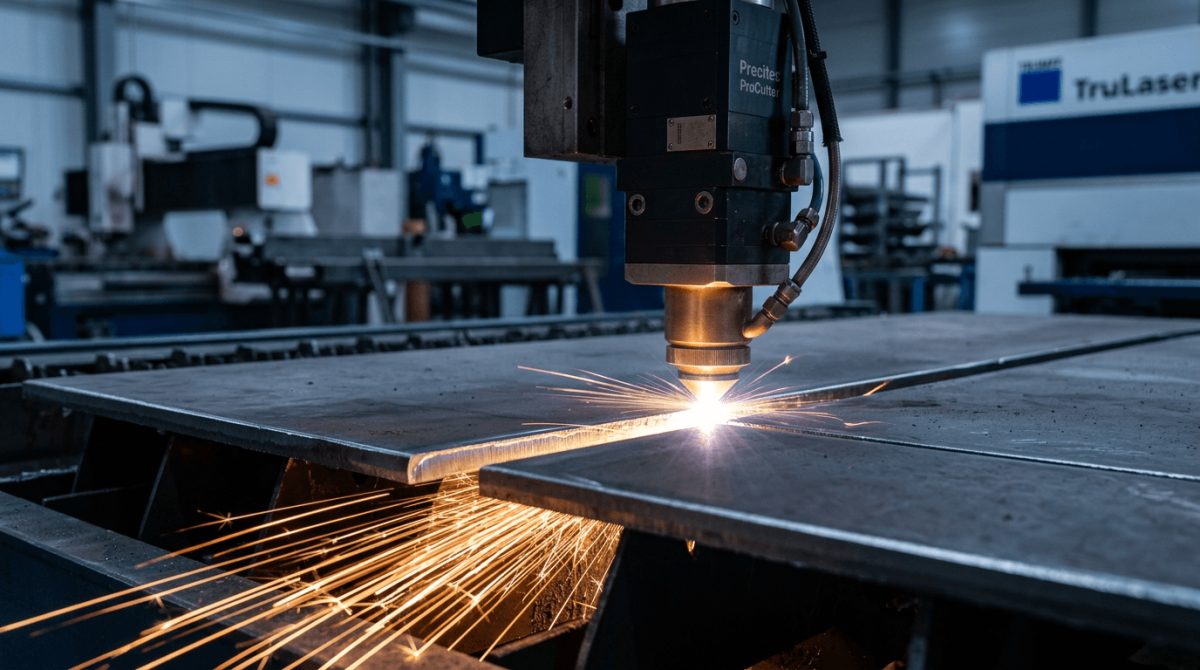
Fiber laser cutting is an inherently precise, non-contact process, but the final accuracy of a finished part depends on several interacting factors:
- Material type and grade. Mild steel, stainless steel, aluminium, brass and copper each respond differently to the cutting process.
- Sheet thickness. Thinner material generally holds tighter tolerances than thick plate, where the kerf and heat-affected zone become more significant.
- Thermal effects. Localised heating can introduce minor distortion, particularly on large or slender profiles.
- Material flatness and internal stress. Sheet that is not flat, or that carries residual rolling stress, can move as it is cut.
- Feature size and geometry. Small holes, narrow slots and fine internal corners are governed by the beam and nozzle geometry.
Typical tolerances in practice
As a general guide, fiber laser cutting of thin gauge sheet commonly holds profile tolerances in the region of a few tenths of a millimetre, with accuracy relaxing progressively as thickness increases. Rather than treating a single figure as universal, it is more reliable to confirm the achievable tolerance for your specific material, thickness and feature set. Where a critical dimension is involved, we recommend calling it out explicitly on the drawing so it can be reviewed before production.
Best practice: apply a general tolerance to the drawing as a whole, and reserve tight tolerances only for the features that genuinely require them.
How to specify tolerances on your drawing
Clear documentation prevents costly misunderstandings. When preparing a drawing or model, consider the following:
- State a general tolerance block, and dimension critical features individually.
- Identify datum references so that measurements are taken consistently.
- Flag features that require secondary operations, such as tapped holes or reamed bores.
- Indicate the material grade and thickness, and the required surface condition.
Our capability
At Fabronix Laser Tech, cutting is performed on a fiber laser with a 6.5 × 2.5 m bed, supported by nesting software that optimises material yield. The platform processes mild steel up to 25 mm, stainless steel up to 20 mm and aluminium up to 10 mm, as well as brass and copper. Every enquiry is reviewed for manufacturability before a quotation is issued, so any tolerance concerns are identified early rather than discovered in production.
If you have a drawing with specific tolerance requirements, our team is glad to review it and confirm what is achievable. You are welcome to send a DXF, DWG or STEP file, or a clear PDF, through our enquiry form to begin the conversation.
Have a drawing you want reviewed?
Send it over and we will review it for manufacturability and respond with a quotation.
Get a Quote